In memory of Bernd Wilde, DL7APV (sk), who passed away on April 14, 2024. The information on these pages was copied from his website www.dl7apv.de and is republished to the best of my knowledge by DM9EE, with the kind permission of Astrid, as a remembrance of Bernd. See also my own page about Bernd: DL7APV (sk).
The Doppler part is complete below. The lower half of Bernd’s Doppler page is an older copy of the “Hints to start EME” page (station, preamps, tuning); it is not repeated here.
Doppler on 432 MHz
The first thing to remember on 432 MHz (and much more on the higher bands) is the Doppler shift. It can be as high as 1 kHz on 432 MHz, and I know of several QSOs that failed because people did not pay attention to it. We have to look at different cases:
1. Random QSOs. Station A calls CQ on 432.010. His program shows a Doppler shift of +600 Hz (moonrise, moon in the east), so he sets his RIT to +600 Hz and hears his echoes clearly. Station B has the moon in the west and a Doppler of –300 Hz. He sets his RIT to –300 Hz and hears his echoes. B now turns his VFO knob and hears A (with RIT at –300 Hz). He can reply, and A hears B on the frequency where A hears his own echoes. That’s fine for random QSOs.
2. Skeds. In every sked you should announce your TX frequency. As in case 1, A transmits on 010 with RIT, and B answers as described. If you don’t hear A in a sked, set your TX to the sked frequency 010 and use your RIT to find A. The VK3UM planner shows all 3 Doppler shifts between you and the DX station (if selected), for example: A home–A home +567, A home–B DX –165, B DX–B DX –1096. If neither has RIT activated, A hears his echoes 567 Hz above his TX frequency, B hears his echoes 1096 Hz below his TX frequency, and A and B hear each other 165 Hz below their TX frequencies. So for a sked both set their TX to 010, and with the RIT at –165 Hz they will hear each other.
WSJT shows different Doppler shifts depending on whether a locator is entered in the Grid field. If the grid is blank, you see Doppler home–home. If it contains the locator of the DX station, the Doppler shift home–DX is shown. That’s a bit confusing, but OK.
3. The frequency on the moon. This time we count the frequency as a listener on the moon (moon RX) would see it. For everyone, the frequency on the moon is the TX frequency plus half of their own Doppler shift. Example: two stations run a sked on 432.1000 MHz. Station A has a Doppler shift of +600 Hz (for own echoes), station B one of –800 Hz.
- Station A tunes his TX to 432.0997 MHz = 432.1000 MHz – ½ x 600 Hz, so his signal appears on the moon at 432.1000 MHz. To hear his echoes, A tunes his RX to 432.0997 + 600 Hz = 432.1003 MHz.
- Station B tunes his TX to 432.1004 MHz = 432.1000 MHz + ½ x 800 Hz, so his signal also appears on the moon at 432.1000 MHz. To hear his echoes, B tunes his RX to 432.1004 – 800 Hz = 432.0996 MHz.
So both stations hear their own echoes, and on the same frequency they hear the other station. This method has all the advantages: the frequency is exactly defined and independent of the location on earth; both stations hear their own echoes and the other station on the same frequency; and on random we can use the same RIT setting to make QSOs like on tropo. With this method the operator has to retune both RX and TX frequency as the Doppler changes during the moon pass. Best is to use 100 Hz steps: easy to hear by ear, and in JT no big deal, as it can be seen in the waterfall. Especially in JT, don’t tune while transmitting – use the 5 seconds while the computer is decoding.
On 2 m this is no big deal, as the Doppler is not so high, but on 432 MHz we have up to 1 kHz, and I remember several cases where QSOs failed because of wrong Doppler compensation at one or both stations.
Spatial offset and Faraday
In my years of EME I realized that I could work very small stations in Europe and JA, but I always had problems working small horizontally polarized stations in the US. I believe many of you with horizontal polarization have had the same experience. Two effects cause this. The first is the spatial offset between two stations, which depends only on their locations and the position of the moon. The VK3UM planner with its spatial offset calculator makes it clear: EU to EU is always below 20°, meaning losses of about 1 dB. Remember, 45° is a loss of 3 dB.
JA mostly has 90° offset to EU, but the JA stations are vertically polarized, so it fits perfectly. We have the same offset with the US, but they use horizontal polarization as we do in Europe. So we have a polarization offset close to 90°, which means an extra loss of 10 or 20 dB – not acceptable on EME. But we can make QSOs with the US from time to time, and there are reports that the US stations hear us but we don’t hear them, and vice versa.
The reasons: one of the stations has polarization rotation or cross yagis, or, second, Mr. Faraday turns the polarization. The earth’s magnetic field rotates the polarization of the radio wave several times as it passes through the ionosphere on the way to the moon and back. This causes not only the desired 90° turn, but any angle between 0 and 90° – and to make it really complicated, the effect is not reciprocal. The polarized waves can also be split into many different polarizations, so even with polarization rotation or H + V antennas we have a big loss, which looks like absorption. As we know, Murphy always turns it to a bad angle when we have only one sked with THE MEGA-DXpedition. HI!!
The fading observed on EME is caused by Faraday rotation and by libration. As viewed from earth, the moon appears to rock back and forth on its axis; this motion is called libration. Both effects cause deep and fast QSB. This QSB can cut a dash or a dot out of a CW letter, so you hear a station loud but cannot decode the callsign. Experience shows that an optimal CW speed is needed to make a QSO under such conditions. The perfect solution is cross polarization as on 23 cm, but on 432 MHz this causes other problems for yagi stations; with dishes it is so easy. We have observed times when libration is lower than at others, but no way to calculate it is available. Faraday is not predictable either. We know it is a bit less during sunspot minimum, and that aurora causes absorption and extra loss, but we cannot calculate it. In my mind this makes skeds and random QSOs even more of a challenge, because you cannot predict everything. You have to try and retry until a QSO succeeds.
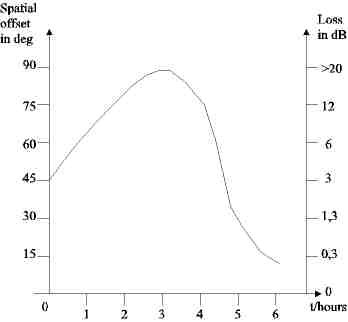
Here is a practical example of the spatial offset problem. The chart below shows the spatial offset during a window EU–US. At US moonrise we have 45° offset, 3 dB extra loss. Halfway through the window the offset turns to nearly 90°, > 20 dB extra loss. At EU moonset the angle drops below 30°, 1 dB loss – this is the best chance for a sked, if the other parameters fit as well. Europe to the northwest US is much worse: from my QTH to KA7V in Oregon it is always > 70°, > 10 dB loss. This makes it very hard for linearly polarized stations to complete a QSO. Better is the path EU to VK5, where the spatial offset is always below 30°, 1 dB loss.
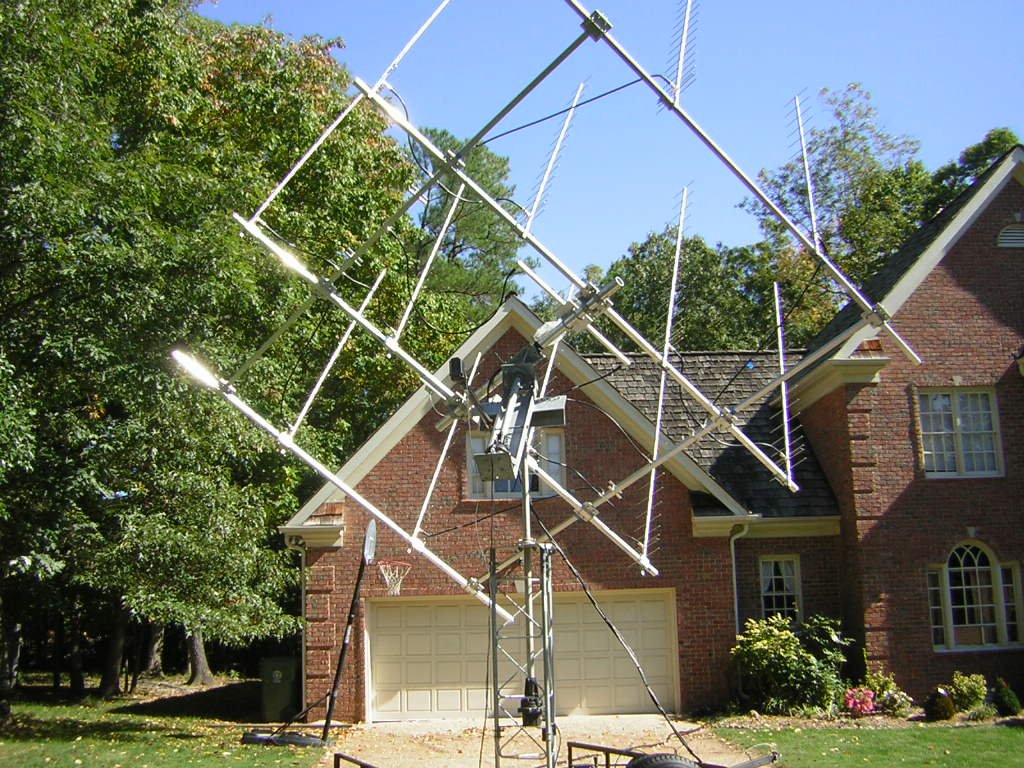
The antenna below shows how to solve the polarization problem. Or use a dish!
Libration
Libration in latitude has shown the greatest effect during the tests by SV3AAF. Libration in longitude (thin sine curve) has not shown a significant effect. Anyway, for most of 2009 they almost coincide, so it will be more difficult to distinguish for someone who does not have the experience of 2008.
For the moment the most important point: if you make echo tests of your own to study libration, please correlate your observations with the lunar declination. At higher positive declinations I expect clearer results for the highs and lows of the libration effect. Perigee is less relevant and should rather be avoided for libration tests in the second half of 2009, because it doesn’t coincide with high moon in the northern hemisphere. An audio spectrum waterfall monitor like Spectran can help the observation, always together with our good ears.
Tnx to SV3AAF for this info!! Maybe all of us can check whether this fits our own observations. More theory: Wikipedia: Libration.
Last update by Bernd: August 2017.